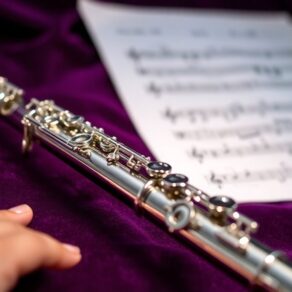
Finger technique exercises are vital for your development as a flute player. Start with finger independence drills, like scales using two fingers, to enhance dexterity. Focus on keeping your fingers curved and relaxed while practicing deliberate lifts to strengthen coordination. Incorporate speed drills at a slow tempo, gradually increasing speed with a metronome. To improve precision, ensure proper finger placement and pressure. Master these techniques, and you’ll refine your skills further as you explore more advanced methods.
Key Takeaways
- Practice finger independence drills by playing scales with two fingers to improve dexterity and coordination.
- Focus on keeping fingers curved and relaxed while hovering over the keys for optimal hand positioning.
- Use chromatic scales and challenging rhythms to gradually enhance speed and accuracy in finger movements.
- Incorporate deliberate finger lifts and alternating fingers on a single note to reinforce coordination.
- Maintain a progress journal to document practice sessions and set specific goals for finger technique improvement.
Why Finger Technique Matters for Flute Players
Although many beginners focus on sound production and breath control, mastering finger technique is equally crucial for flute players. Your finger dexterity directly affects your ability to play complex passages smoothly and accurately. When your fingers can move swiftly and precisely, you open up a world of musical possibilities.
Building muscle memory through consistent practice allows you to execute fingerings with ease, freeing your mind to concentrate on expression and dynamics. To develop this essential skill, pay close attention to your finger placements and movements. Make sure each finger lifts and lands cleanly on the keys, avoiding unnecessary tension.
As you practice, consider using a metronome to gradually increase your speed. This not only enhances your timing but also helps solidify those fingerings in your muscle memory.
How to Perform Essential Finger Exercises for Better Agility
To enhance your finger agility, incorporate specific exercises into your practice routine. Begin with simple finger independence drills. For example, play a scale using only your index and middle fingers while keeping the others still. This not only builds independence but also strengthens your dexterity.
Next, focus on hand positioning. Ensure your fingers are curved and relaxed over the keys. When practicing, lift each finger deliberately, allowing the others to remain engaged. Try alternating between fingers on a single note, like C to D, to reinforce coordination.
You can also use chromatic scales to challenge your speed and accuracy. Start slowly, prioritizing clarity of each note. Gradually increase your tempo while maintaining control.
Consistent practice of these exercises will lead to better finger agility, ultimately enhancing your overall flute playing experience. Remember, the more you dedicate yourself to these techniques, the more natural they’ll become!
Speed Drills to Enhance Finger Coordination
As you aim to enhance your finger coordination, speed drills become essential tools in your practice arsenal. Start with simple patterns like scales or arpeggios at a slow tempo, gradually increasing your speed. Focus on finger independence; ensure each finger moves fluidly without affecting the others.
Next, incorporate exercises that target coordination challenges. For instance, try alternating fingers on chromatic scales, emphasizing even tempo and clean transitions. Use a metronome to set a steady pace, pushing your limits while maintaining accuracy.
Finally, introduce challenging rhythms or syncopated patterns to further develop your coordination. As you progress, remember that consistency is key.
Practice these drills daily, and don’t hesitate to revisit slower tempos as needed. Embrace the journey of improvement—your dedication will foster a deeper connection with your flute, enhancing not just your technique but also your musical expression.
Techniques to Improve Precision in Note Production
Improving precision in note production is crucial for delivering a clean and expressive performance on the flute. Start by focusing on your finger placement; ensuring that your fingers are positioned correctly over the keys will enhance your control and accuracy.
Practice slowly, allowing your fingers to settle into position before you play each note. This mindful approach helps you develop muscle memory, which is essential for achieving note clarity.
Incorporate the use of a metronome to maintain a steady tempo as you practice, gradually increasing the speed while ensuring that each note rings out clearly. Pay attention to the pressure you apply; too much can lead to muffled sounds, while too little may cause notes to be weak.
Finally, regularly record yourself and listen critically to identify areas for improvement. By focusing on these techniques, you’ll cultivate a more precise and polished sound on your flute.
Incorporate Finger Exercises Into Your Practice Routine
Incorporating finger exercises into your practice routine is essential for developing agility and dexterity on the flute.
These exercises not only enhance your finger strength but also improve your overall musicality.
Follow these four steps to integrate finger patterns into your warm-up routines:
- Choose Specific Finger Patterns: Start with basic scales and arpeggios to familiarize yourself with finger placements.
- Set a Timer: Dedicate 5-10 minutes at the beginning of each practice session for focused finger exercises.
- Vary the Speed: Gradually increase the tempo as you become more comfortable with the patterns—this builds muscle memory and coordination.
- Incorporate into Pieces: Apply the finger patterns to pieces you’re working on, ensuring they become second nature.
How to Track Your Progress and Set Goals?
Tracking your progress and setting goals is crucial for achieving mastery on the flute. Start by maintaining a progress journal, where you can document daily practice sessions, exercises completed, and improvements noticed. This not only keeps you accountable but also builds a sense of accomplishment as you see your growth over time.
For effective goal setting, break your objectives into short-term and long-term milestones. Short-term goals might include mastering a specific finger technique or increasing your speed, while long-term goals could focus on preparing for a performance or audition. Be specific: instead of saying, “I want to play better,” aim for “I want to play scales at 120 BPM by next month.”
Regularly review your progress journal to adjust your goals as needed. Celebrate small victories along the way; they’ll foster a sense of belonging within your musical journey.
This structured approach will guide you toward consistent improvement and greater mastery.
Frequently Asked Questions
What Age Is Best to Start Finger Technique Exercises?
The optimal age to start finger technique exercises is around 6 to 8 years old. At this stage, kids are developing fine motor skills, and introducing these exercises can enhance their dexterity and coordination.
You’ll notice significant developmental benefits, as their fingers gain strength and agility. Starting early fosters a solid foundation, encouraging a lifelong love for music.
Can Finger Exercises Help With Breathing Techniques?
Absolutely! Finger exercises can significantly enhance your breath control and finger coordination.
Picture yourself cruising down the highway; just as you need to steer smoothly, you need to synchronize your fingers and breath while playing.
By practicing finger techniques, you develop muscle memory, which allows you to focus on your breath without overthinking.
This synergy not only improves your overall performance but also makes playing more enjoyable, fostering a deeper connection with your instrument.
How Long Should I Practice Finger Exercises Daily?
You should practice finger exercises daily for at least 15 to 30 minutes.
This time allocation allows you to build muscle memory and dexterity without overwhelming yourself. Start with shorter sessions and gradually increase as you feel more comfortable.
Consistency is key, so try to stick to your routine. Remember, regular practice not only improves your skills but also helps you feel more connected to your instrument and fellow musicians.
Are There Specific Exercises for Beginners Versus Advanced Players?
Yes, there are specific exercises for beginners and advanced players.
As a beginner, focus on simple finger drills that help you learn the basic fingerings and coordination. Once you’re comfortable, advance to more complex techniques, like scales and arpeggios, which challenge your speed and accuracy.
Incorporate rhythmic variations to enhance your skills further. Remember, consistent practice is key, no matter your level, and it helps build a solid foundation for your playing journey.
How Do Finger Exercises Affect Overall Musicality and Expression?
Finger exercises sculpt your dexterity like a potter shaping clay, enhancing your musical expression.
As you practice, you’ll notice your fingers becoming more agile, allowing you to navigate complex pieces with ease. This improved dexterity translates into greater emotional depth in your playing, enabling you to convey nuances and dynamics more effectively.
Conclusion
By weaving finger technique exercises into your daily practice, you’re not just sharpening your skills—you’re crafting a musician’s tapestry rich in agility and precision. Think of your fingers as nimble dancers, gliding effortlessly across the keys. As you track your progress and set goals, remember that each small improvement brings you closer to the symphony you aspire to create. Embrace the journey, and soon, your flute will sing with the clarity and finesse you’ve always dreamed of.